
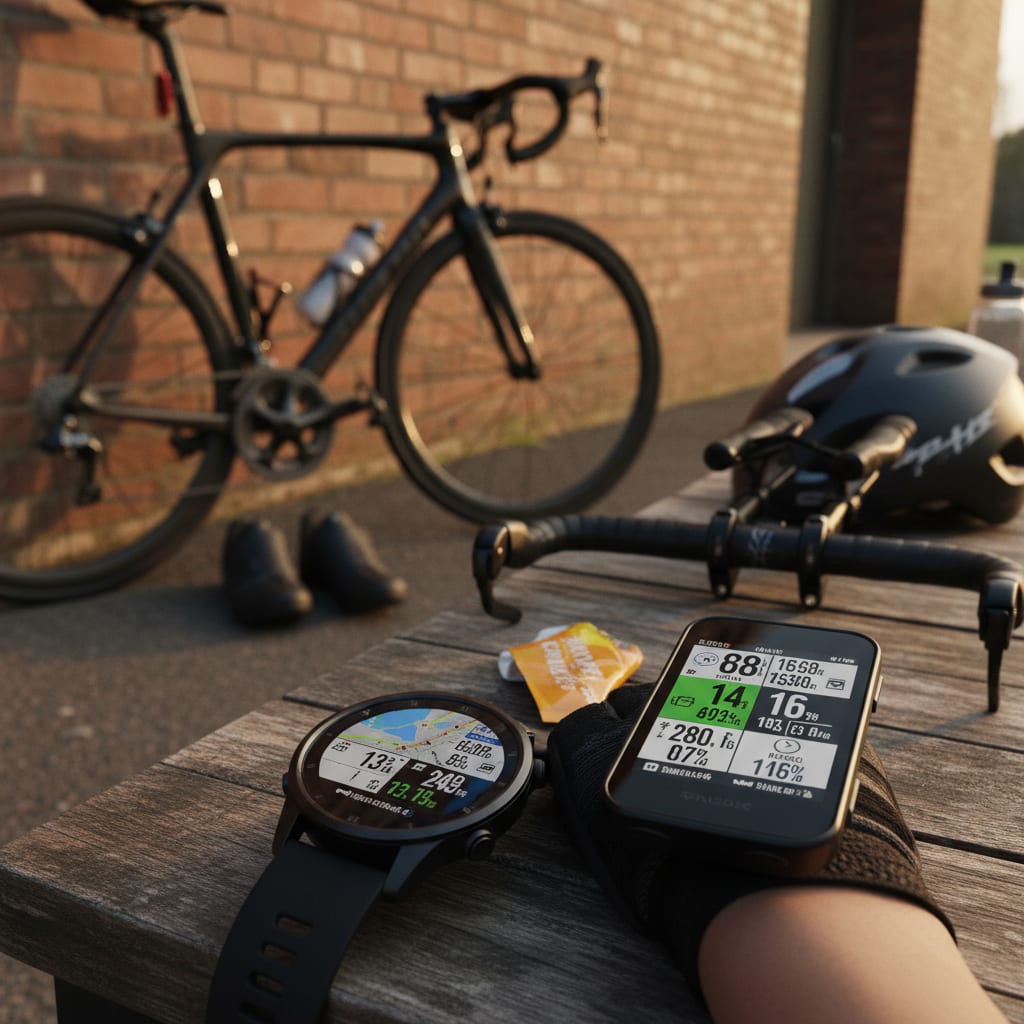
GPS Watch vs. Bike Computer: Why Most Triathletes Are Running Both and Paying Too Much for It
The Triathlon GPS Watch vs. Bike Computer Split: Why Running Both Is Costing You More Than Money
Here’s a question most triathletes never ask themselves: when you snap your Garmin Edge onto your stem and strap your Garmin Fenix to your wrist before a ride, what exactly is the second device actually doing for you?
For a lot of athletes, the answer is “not much.” You’re carrying redundant hardware, paying for redundant subscriptions, and – on race day – adding transition complexity you don’t need. Let’s break down where each device earns its spot and where you’re just spending money out of habit.
—
What Does a Bike Computer Actually Do Better Than a GPS Watch?
A dedicated bike computer wins on screen size, data density, and power meter integration – these are real performance advantages, not marketing noise.
The Garmin Edge 540 and Wahoo ELEMNT Bolt v2 both offer a screen you can actually read at 30 km/h. They support multiple data fields simultaneously without squinting. More importantly, they handle power meter data with significantly lower latency and smoother display refresh than most GPS watches – which matters when you’re trying to hold 260 watts on a climb.
Bike computers also tend to handle multi-device Bluetooth and ANT+ pairing more reliably. Running a power meter, a smart sensor on the rear wheel, and a heart rate strap simultaneously is where a dedicated device earns its place.
Specific wins for bike computers:
- Larger, more readable display in direct sunlight
- Better power meter compatibility and data smoothing
- Robust navigation with turn-by-turn routing (the Edge 540 Solar excels here)
- Longer battery life during bike-only use
—
What Does a GPS Watch Do Better Than a Bike Computer?
A GPS watch covers all three triathlon disciplines in a single device – swim tracking, run metrics, and transition timing – which a bike computer simply cannot do.
This is the GPS watch’s core advantage. A Garmin Forerunner 965 or Apple Watch Ultra 2 tracks your swim laps, records your T1 and T2 splits, and picks up cadence, pace, and heart rate the moment you’re on the run course. No bike computer does any of that.
Watches also give you wrist-based optical heart rate, which – while not perfect – removes the need for a separate chest strap on training days when you’re not chasing precision data.
For most training rides that don’t involve power data or serious navigation, a GPS watch mounted on a cheap out-front adapter (the K-Edge Garmin Combo Mount is around $40) does the job cleanly.
—
Where Do They Genuinely Overlap – and Is That Overlap Worth Paying For?
The overlap zone is speed, distance, heart rate, and basic ride metrics – data any modern GPS watch handles without issue.
If you’re paying $350 for a Wahoo ELEMNT Bolt on top of a $600 Garmin Forerunner 965, and your bike computer is primarily showing you speed, distance, and heart rate, you’re duplicating $350 worth of capability. That’s money that could go toward a faster tyre set or a quality trisuit.
The honest overlap checklist:
- GPS distance and speed: both do it equally well
- Heart rate monitoring: both handle it (chest strap improves accuracy on either)
- Elapsed time and lap splits: identical on both
- Strava sync and post-session analysis: both connect automatically
—
So When Should You Actually Run Both Devices?
Run both when you’re training or racing with a power meter and need real-time power data displayed clearly alongside navigation – that’s the one scenario that justifies the setup.
If you’re a competitive age-grouper who trains with power and uses structured workouts from TrainingPeaks or Intervals.icu, a bike computer earns its keep. Power data is the single biggest bike computer differentiator. A Garmin Fenix 7 can pair with a power meter, but the display experience and data reliability still lag behind a dedicated unit.
Skip the bike computer if:
- You train and race without a power meter
- Your rides are under four hours (most Olympic and Sprint triathletes)
- You’re not navigating unfamiliar routes regularly
- You’re in the first two years of the sport and still building base fitness
—
FAQ
Can a GPS watch replace a bike computer for triathlon training? Yes, for most amateur triathletes it can. A GPS watch handles speed, distance, heart rate, and multi-sport tracking well. The exception is structured power-based training, where a dedicated bike computer offers a meaningfully better experience.
What is the best GPS watch for triathletes who want to ditch the bike computer? The Garmin Forerunner 965 is the current benchmark – it covers swim, bike, and run with strong GPS accuracy, a readable display, and power meter support if you add one later.
Does a bike computer add weight that affects race performance? At around 80-100 grams for most units, a bike computer is unlikely to affect your finish time. Transition time and pacing decisions matter far more.
Can I use my GPS watch for bike navigation? Yes, though the small screen makes complex routes harder to read at speed. For a known race course or simple point-to-point training rides, it works fine.
Is it worth buying a bike computer as a beginner triathlete? Not immediately. Start with a solid GPS watch and add a bike computer only when you’ve invested in a power meter and need structured power-based training.
—
The takeaway: if you don’t train with a power meter, one good GPS watch mounted on your bars will cover 90% of what you actually need – in all three disciplines. Buy the second device when you have a specific reason for it, not because it’s what triathletes do.

